
 Call us now:


Imagine you are about to execute a complex cross-chain arbitrage or move large liquidity between protocols from your laptop in New York. One wrong approval, one blind-signed transaction, and your position is at risk. That concrete, practical stake is the right way to open an evaluation of Rabby: a non-custodial, multi‑chain wallet that places transaction simulation and risk scanning at the center of the signing flow. This article walks through how to install and integrate Rabby as a browser wallet, why its core mechanisms matter for active DeFi users in the US, where it trades off convenience for safety, and what to monitor as the ecosystem evolves.
My goal is not to sell Rabby; it’s to explain how the product works under the hood, compare it to comparable EVM wallets, and give you decision-useful heuristics: when Rabby reduces expected operational risk, when it does not, and how to combine it with other controls (hardware wallets, multisig) for institutional-strength security.
What Rabby does differently (mechanisms, not slogans)
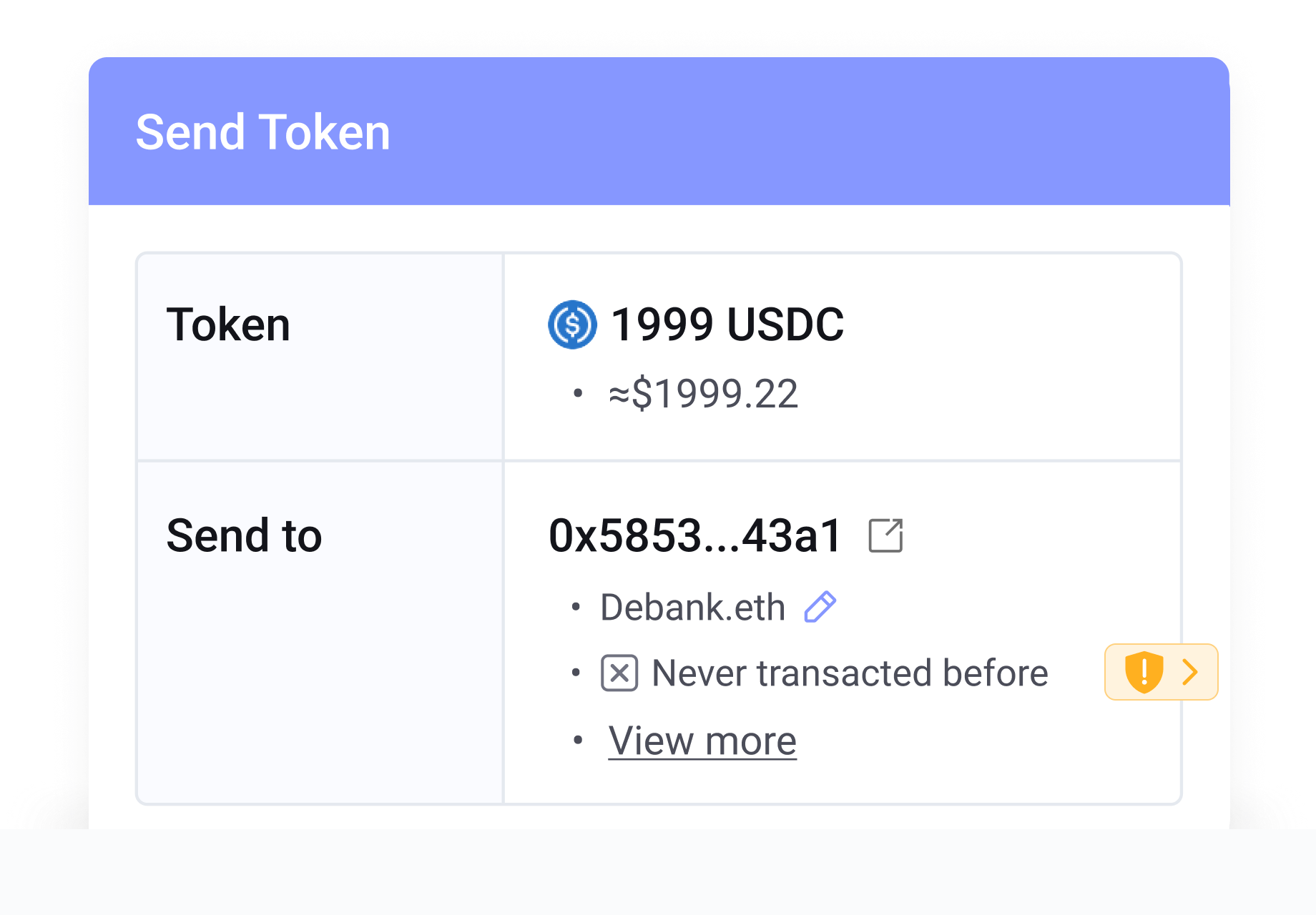
Rabby is architected around a few concrete mechanisms that change the user decision problem at the moment of signing. First, transaction simulation: before signing, Rabby executes a dry‑run of the transaction against the chain state and surfaces estimated token balance changes and gas costs. That converts a black‑box signing decision into a set of numerical outcomes you can verify. Second, pre‑transaction risk scanning: an integrated security engine flags known hacked contracts, suspicious approval sizes, and non-existent recipient addresses. Third, automatic network switching: the extension detects the dApp network and swaps networks for you—reducing user error when interacting with multi‑chain protocols. Fourth, cross‑chain gas top‑up: if you have assets on chain A but need gas on chain B, Rabby offers a built-in top‑up flow to fund transactions without juggling wallets.
Mechanically, these features shift two classical failure modes. They reduce (1) blind signing risk—the chance you authorize a contract that will drain funds because you couldn’t see the effective balance changes—and (2) network-mismatch errors that lead to failed transactions or accidental approvals on the wrong chain. For active DeFi users who routinely call contracts, those two improvements directly lower operational risk by improving information at the decision point.
Installing Rabby as a browser wallet: step-by-step and best practices
Rabby is available as a browser extension for Chromium-based browsers (Chrome, Brave, Edge). Installing the extension is straightforward, but the security and operational choices you make during setup matter. Start from a trustworthy source—the project’s official page—and verify the extension metadata with your browser store. A useful starting point is the project’s documentation page: https://sites.google.com/cryptowalletextensionus.com/rabby-wallet/, which centralizes platform links and notes.
During setup choose between creating a new seed (clean start) or importing an existing seed phrase. For power users and institutions, the preferable pattern is to avoid storing large balances in a browser-only seed. Instead: (1) use Rabby as an interface only and connect a hardware wallet (Ledger, Trezor, Keystone, etc.), (2) or connect to a multisig gateway like Gnosis Safe for higher-value operations. Rabby’s hardware wallet compatibility and integrations with custodial/multi-sig providers (Fireblocks, Amber, Cobo) are explicit design choices to encourage separation of concerns: Rabby for UX and simulation, hardware or multisig for custody.
Enable the extension permissions conservatively. Do not grant blanket access to all websites; instead, configure site access to the specific dApps you use. Turn on automatic network switching if you value convenience, but be aware it changes the visible network without user input—review the network indicator before signing trades with large slippage or complex contract interactions.
Comparative trade-offs: Rabby vs. MetaMask-like alternatives
Rabby sits in a crowded space. MetaMask, Trust Wallet, and Coinbase Wallet are commonly used alternatives. The meaningful differences are mechanistic rather than cosmetic: Rabby simulates transactions and performs pre-signature risk scans by default; MetaMask historically presented more minimal pre-sign checks and relied on external tooling. One consequence: Rabby reduces information asymmetry at signing, which is valuable for high-frequency or complex DeFi interactions. The trade-off is marginal latency and occasionally extra friction when the simulation flags ambiguous behaviors that require user interpretation.
A second trade-off relates to fiat onboarding and staking. Rabby currently lacks a built-in fiat on‑ramp and native in‑wallet staking. If your operational needs include buying crypto with a bank card inside the wallet or unstaking/staking directly inside the UI as a single flow, Rabby will require supplementary services or external staking interfaces. For many power users this is acceptable—the expectation is that treasury and funding are managed off‑wallet with dedicated infrastructure—but it’s a practical limitation to note for US users who prefer a single integrated experience.
Security posture trade-offs are also clear. Rabby’s open-source MIT license supports independent auditability; its prior incident (the Rabby Swap contract exploit in 2022) demonstrates both risk and remediation. The team froze the vulnerable contract, compensated users, and increased audit rigor. That episode is a reminder that open-source and audits reduce but do not eliminate smart contract risk. For high‑value activities, combine Rabby with hardware keys and multisig to convert protocol-level risk into institutional controls.
How transaction simulation and approval revocation change the decision model
Two features deserve a deeper mechanism-level look because they reshape everyday behavior. First, transaction simulation: Rabby runs a dry‑run against a JSON‑RPC node to estimate effects. This is not infallible—simulations rely on current mempool and contract state and cannot perfectly predict future on‑chain state if your transaction is time-sensitive or if front‑running is likely. However, simulations convert a signing decision from probabilistic guesswork into concrete numeric expectations: token deltas, gas, and potential revert conditions. That helps you set slippage, gas limits, and whether to pause a multisig execution.
Second, approval revocation: ERC‑20 approvals create persistent attack surface because unlimited approvals allow contracts to pull tokens at any time. Rabby’s native revocation tool surfaces active approvals and lets you revoke them. This reduces exposure but introduces usability questions: frequent revocation adds transaction costs and bookkeeping. For power users, a practical heuristic is to keep tight approvals for high-value tokens and allow broader approvals for small-ticket utility tokens where revocations would be net-loss due to gas fees.
Operational checklist for DeFi power users in the US
Before routing large flows through Rabby, validate the following checklist: (1) Connect via a hardware wallet for signing high-value transactions; (2) Use Rabby’s simulation on every contract interaction—treat the simulation as an assertion, not an oracle; (3) Keep allowance scopes tight and use the revocation tool periodically; (4) For institutional volumes, pair Rabby with a multisig/router like Gnosis Safe; (5) Maintain off‑wallet custody for treasury fiat onboarding because Rabby has no fiat rails; (6) If you rely on staking rewards, use a dedicated staking provider since Rabby lacks native staking flows.
These steps reflect where Rabby materially reduces expected loss (better signing information and approval management) and where it leaves gaps (fiat on‑ramp and in‑wallet staking). Combining Rabby with external custody and funding infrastructure yields a pragmatic balance between operational agility and robust controls.
Limits, unknowns, and what to watch next
Rabby’s strengths are explicit, but limitations deserve equally blunt attention. Simulation accuracy depends on node fidelity and the absence of race conditions; it cannot prevent front‑running or MEV that executes between simulation and inclusion. Contract-level risk scanning is only as good as the threat intelligence feed; zero‑day exploits and novel attack patterns will not be pre-flagged. The 2022 Rabby Swap exploit shows that even wallets and associated dApps can be attack vectors—remediation is possible, but the presence of past incidents means you should not assume immunity.
What to monitor next: (1) expansion of fiat on‑ramp partnerships—if Rabby adds native fiat rails it will change funding workflows in the US; (2) additions to native staking support—on‑wallet staking would lower friction for yield capture but may increase custody surface; (3) improvements in simulation to account for MEV or on‑chain race conditions—progress here would materially lower execution risk for time‑sensitive DeFi strategies. Each signal would alter the heuristic described above and deserves operational testing under low-stakes conditions before trusting with live treasury.
FAQ
Is Rabby safe enough to hold large amounts on desktop?
Rabby improves the decision environment by simulating transactions and scanning for known risks, which reduces some classes of user error. But a browser extension is still higher risk than cold storage or a multisig-controlled vault. For large holdings in the US, the recommended pattern is to use Rabby as a signing interface combined with hardware wallets or multisig custody (Gnosis Safe, Fireblocks). That keeps private keys off a browser-only seed and provides recovery and governance controls suited to institutional risk tolerances.
Can Rabby prevent phishing or malicious dApp behavior?
Rabby’s pre-transaction risk engine can flag suspicious contracts and approvals, which helps against some phishing flows that rely on blind signing. However, it does not replace good operational hygiene: verify dApp URLs, avoid pasting seed phrases, and restrict extension permissions. Phishing that reproduces legitimate contract addresses or uses social engineering remains a non-trivial threat.
How accurate are Rabby’s transaction simulations?
Simulations provide valuable estimates of token changes and gas but depend on node state and are not guarantees. They may mismatch reality when the chain state changes between simulation and inclusion, or when transactions are front‑run. Treat the simulation as a high‑quality diagnostic, not a deterministic oracle.
Does Rabby support all EVM chains and hardware wallets?
Rabby supports over 90 EVM-compatible chains including Ethereum, BNB Chain, Arbitrum, Optimism, Polygon, and Avalanche, and integrates with many hardware wallets (Ledger, Trezor, Keystone, CoolWallet, GridPlus, BitBox02). For niche chains or newer hardware, confirm compatibility before relying on them for production operations.
Final decision heuristics
If you are a DeFi power user in the US who frequently interacts with contracts and needs multi‑chain convenience: Rabby is worth testing because its simulation and revocation tools change the marginal risk of signing complex transactions. If you run institutional volumes, treat Rabby as a secure interface layer combined with hardware keys and multisig. If you require fiat on‑ramp or integrated staking as a single workflow, expect to use additional services because Rabby currently lacks those native rails.
In short: Rabby reduces information asymmetry and approval risk at the moment of signing—two key levers for lowering operational loss—but it is not a panacea. Use its strengths deliberately, complement it where it is thin, and monitor the product signals listed above to update your operational playbook as the wallet evolves.